Pure polycarbonate flexes on impact and rebounds to shape; the cheaper ABS composite found on most bags at this price cracks instead.
22" × 14.5" × 9" unexpanded — confirmed to fit overhead bins on American, Delta, United, and Southwest with no gate-check fees.
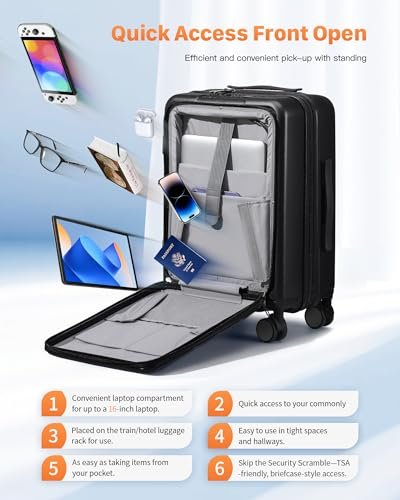
Opens vertically while the bag stays upright, fits up to a 16-inch laptop, and requires zero unpacking to hand a device to a TSA agent.
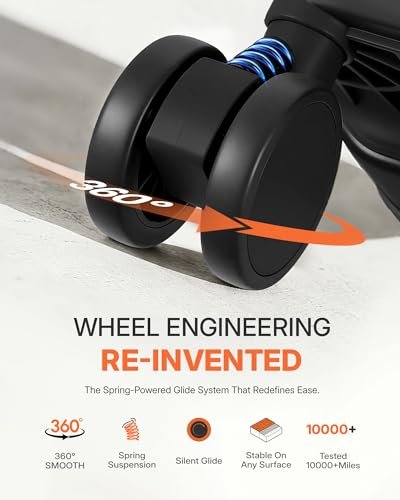
TPE rubber and coil-spring suspension absorb vibration on rough surfaces; the integrated brake keeps the 28-inch checked bag from rolling on slopes.
Two distinct products — a feature-dense 20-inch carry-on in two colorways and a side-opening 28-inch checked bag — built around the same 100% polycarbonate shell and spring-suspension wheels. Check Amazon for current pricing and availability on each.
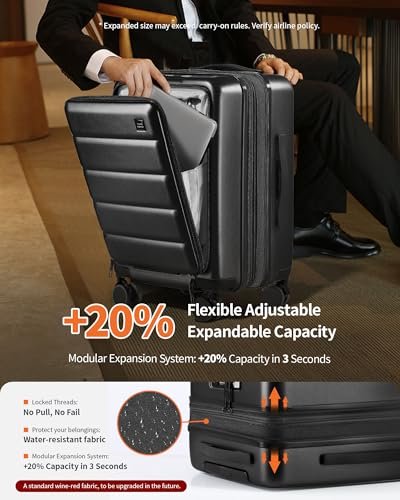
The E701 in black is the most feature-complete carry-on in the lineup — 100% PC shell at 22" × 14.5" × 9" unexpanded, expanding from 38L to 46L, with a front vertical laptop pocket, USB-A and USB-C charging ports, a flip-out cup holder, hidden phone mount, side hook, AirTag slot, TSA combination lock, and spring shock-absorbing wheels. Weighs 8.6 lbs. Backed by a 2-year manufacturer warranty.
The carry-on with USB charging, a laptop pocket that opens without unzipping the main compartment, and spring wheels that roll on one finger — all in a 22" × 14.5" × 9" airline-approved shell.
See on Amazon
Identical specs to the black E701 — same 100% PC shell, 22" × 14.5" × 9" dimensions, 38L–46L expandable capacity, USB-A and USB-C ports, front 16-inch laptop pocket, cup holder, phone mount, AirTag slot, and 2-year warranty — in a Banana Yellow colorway for travelers who want the full feature set without the standard black.
Every spec of the flagship E701 carry-on in a distinctive Banana Yellow finish — same 100% PC shell, same airline dimensions, same spring wheels.
See on Amazon
The 28-inch checked bag opens from the side rather than splitting down the center — which means the full interior depth is usable, not partially blocked by a hinge mechanism. Built from 100% polycarbonate, expandable by 20%, with spring-suspension wheels that include an integrated incline brake, two waterproof wet/dry separation pouches, a hidden privacy compartment, flush cup holder, two side hooks, and an AirTag holder. Weighs 13 lbs at 20" × 12.6" × 30".
The side-opening design gives you 100% usable packing depth — no hinge wasting space — making it the better call for anyone packing tall items like boots or garment bags on longer trips.
See on AmazonIsland Elephant makes solid hardside luggage for regular travelers — not a premium brand, and the honest version of that positioning is more useful than any marketing claim. The 100% polycarbonate shell on the carry-on handles real airport abuse well, the wheels hold up across dozens of trips, and the feature set genuinely outpaces most bags at this price point. But there are specific trade-offs worth knowing before you buy.
This is the most documented complaint across every Island Elephant community — r/PhReview rated the bag 4.4/5 and still called it out directly: the shell scratches, especially when checked. That's not a defect. It's physics. Polycarbonate shells, including those on bags that cost three times as much, pick up surface marks from conveyor belts, baggage handlers, and carousel edges. The structure underneath stays intact — a scratch doesn't weaken the shell or compromise the zipper track. It's cosmetic wear, not structural failure.
If surface appearance matters to you, the Wine Red and Banana Yellow colorways tend to show light marks less visibly than gloss black. Matte-finish polycarbonate scatters light differently — fine scratches blend in rather than catching it.
The telescoping handle on the E701 carry-on is functional for everyday use. It's not the reinforced aluminum-alloy construction you'd find on Away or Samsonite Pro S — and at this price, that's an honest trade-off. For travelers who carry on and handle their own bag, it holds up well. For those who check frequently and let handlers throw it around, the handle is the component most likely to show wear first. One Facebook travel group user reported a bag arriving with minor damage near the handle area — worth knowing, not worth panicking over.
The carry-on's water-resistant fabric liner protects against light spills and light rain — a splash on the conveyor, a drizzle between the terminal and the jetway. It's not waterproof. Don't pack electronics loose and expect the interior to stay dry in a downpour. The wet/dry separation pouch inside the main compartment is a better line of defense for anything that absolutely can't get damp.
Community reports from r/FilipinoTravel document bags surviving Hong Kong, Singapore, Korea, and Japan trips with wheels and zippers fully intact. The spring-loaded wheel suspension — TPE rubber plus coil spring inside each housing — is a genuine engineering difference from the flat plastic spinners on cheaper bags. The zippers use reinforced pulls and hold up to the daily on/off cycle of frequent travel without fraying or sticking.
The honest summary: Island Elephant is the right choice for travelers who fly regularly, don't abuse their bags, and want practical features without paying a premium-brand premium. It's not the last bag you'll ever buy — but for a few years of real travel, it earns its place.
The right choice comes down to three things: how long you're traveling, which airlines you're flying, and how you feel about checked baggage handling. Here's how to think through it without guessing.
The 20-inch E701 measures 22" × 14.5" × 9" unexpanded and holds 38L — enough for 3–4 days of clothes packed efficiently, or 5–7 days if you're packing light and going somewhere warm. It fits overhead bins on American, Delta, United, and Southwest without triggering a gate-check. You keep it with you the entire flight. No waiting at baggage claim. No $35 checked-bag fee on most US carriers.
Expand it and you gain 8 more liters (up to 46L total), which buys you room for a week's worth of items or souvenir space on the return. But expanded, the depth increases enough that budget carriers — Spirit, Frontier, and most international short-haul airlines — may reject it at the gate. If you're flying budget, keep the expansion zipper closed.
The 28" Top-Open Checked bag is a different product for a different travel situation. At 20" × 12.6" × 30" and 13 lbs empty, it's built for checked travel — week-long trips, family vacations, anyone who needs to pack boots, bulkier clothing, or two weeks of items without creative folding.
The side-opening design matters here more than it sounds. Most large checked bags open down the center on a clamshell hinge — which sounds fine until you realize the hinge mechanism eats 2–3 inches of usable depth on each side. The Island Elephant 28" opens from one side, giving you the full depth from top to bottom. That's where boots, tall bottles, and rolled jackets go without folding them in half.
At 13 lbs empty, it's heavier than some competitors at this size — worth factoring in if your airline enforces a strict 50-lb checked-bag limit. A 13-lb bag leaves you 37 lbs for contents, which is still generous for most trips.
A lot of travelers buy both — the carry-on for shorter work trips and the checked bag for family vacations or international travel. They're the same shell material (100% PC), the same wheel system, and the same TSA lock format, so the experience is consistent across both bags. The checked bag adds the side-opening design and an incline brake on the wheels that the carry-on doesn't have; the carry-on adds USB ports, a phone mount, and the front laptop pocket that the checked bag doesn't list.
If you're buying one bag to serve every trip, the carry-on is the more flexible choice — especially if you're disciplined about packing light. If you're regularly checking bags on trips longer than five days, the 28-inch is the more practical call.
Airline bin availability varies by aircraft and route. Even a bag that technically meets size limits can get gate-checked on a full regional jet where overhead space runs out before boarding is complete. This isn't an Island Elephant problem — it happens with every carry-on brand. The only reliable solution is boarding early enough to claim bin space, which means choosing a boarding group that gets you on before the overhead compartments fill.
The standard carry-on size for most major US airlines is 22" × 14" × 9" — that's the measurement airlines use when they're deciding whether your bag fits in the overhead bin without being forced. The Island Elephant E701 measures 22" × 14.5" × 9" unexpanded, which falls within the accepted range for American, Delta, United, and Southwest. Half an inch over the nominal width hasn't been a documented issue in practice.
This is one of the most common points of confusion for first-time carry-on buyers. TSA does not enforce bag size. TSA's job is security screening — they check what's inside your bag, not whether the bag fits in an overhead bin. The airline's gate agents enforce size limits. If a gate agent decides your bag is too large, they can require you to check it at the gate, often for a fee. TSA approval on a lock or a listing means the lock meets certification standards — it says nothing about whether the bag's dimensions are compliant.
That distinction matters practically: a bag that passes through security without comment can still get gate-checked by the airline's boarding team if they're enforcing size rules that day.
Here's how carry-on size limits break down across the airlines most Island Elephant buyers are likely to fly:
These are size limits as published at the time of writing. Airlines update policies without announcement — always verify directly with your carrier before a trip.
When you unzip the E701's expansion panel, the bag grows from 38L to 46L — an 8-liter gain. The depth increases by roughly 1.5–2 inches. Unexpanded at 9" deep, the bag fits the standard 22" × 14" × 9" template. Expanded, it doesn't. That extra depth may push the bag past the overhead bin template at budget carriers or international short-haul airlines with tighter limits.
The practical rule: keep the expansion zipper closed for any flight where bin space is uncertain or where you're flying a carrier that actively enforces size at the gate. Use the expansion for souvenirs on the return leg of a checked-bag trip, or on Southwest where the limits are looser. Don't expand and assume it'll fit — it might not.
Some airlines keep a physical metal frame at the gate called a sizer — if your bag doesn't slide in cleanly, it gets checked. Most major US airports don't use these at every gate, but they do appear more frequently at busy domestic hubs during peak travel periods. The E701 unexpanded passes these frames on American, Delta, United, and Southwest without issue, based on its documented dimensions. Expanded, the outcome depends on the specific frame dimensions in use at that gate.
The E701 carry-on has built-in USB-A and USB-C ports on the exterior of the bag — but they don't generate power on their own. They're pass-through ports: you place a power bank inside the bag, run its cable through the internal routing channel to the port, and then plug your phone or device into the outside-facing port. The bag acts as the housing; the power bank is the actual power source.
Getting this right takes about 30 seconds once you know the setup:
That's it. You're charging from the power bank without opening the main compartment, which means you can charge during a gate wait while the bag stays closed and your contents stay organized.
Power banks are carry-on only — airlines don't allow them in checked luggage. If you're flying with the E701 as a carry-on, keep the power bank inside and declare it if asked during screening. TSA agents are familiar with external USB ports on luggage and typically don't flag them, but the power bank itself may be asked to be removed from the bag during X-ray screening, the same way a laptop would be.
Don't check the E701 with a power bank inside. That's not an Island Elephant rule — it's an FAA requirement that applies to every lithium-ion power bank on every airline.
Any power bank with a standard USB-A or USB-C output cable works. The port opening on the E701 is sized for standard cable connectors — bulky right-angle connectors or proprietary cables may not route cleanly through the internal channel. A slim, rectangular power bank in the 10,000–20,000 mAh range fits comfortably in the front compartment alongside a laptop and still has capacity for 2–4 full phone charges. Island Elephant doesn't include or endorse a specific model, so the choice is yours — but the setup works with virtually any standard power bank you already own.
One thing worth being direct about: buyers who didn't read this before purchasing sometimes expect the ports to work without a separate power bank and discover at the airport that they don't. That's a fixable misunderstanding — but it's better to know before you board than after.
The E701 carry-on comes in Black and Banana Yellow — same shell, same specs, same spring wheels and front laptop pocket. The only real decision is color, but there are a few secondary details worth knowing before you choose.
| Feature | E701 Carry-On Expandable (Black) | E701 Carry-On Expandable (Yellow) |
|---|---|---|
| Shell material | 100% Polycarbonate (PC) | 100% Polycarbonate (PC) |
| Dimensions (unexpanded) | 22" × 14.5" × 9" | 22" × 14.5" × 9" |
| Capacity | 38L unexpanded / 46L expanded | 38L unexpanded / 46L expanded |
| Weight | 8.6 lbs | 8.6 lbs |
| Laptop compartment | Front-access, fits up to 16" | Front-access, fits up to 16" |
| Charging ports | USB-A + USB-C (power bank required) | USB-A + USB-C (power bank required) |
| Warranty | 2-year manufacturer | 2-year manufacturer |
Both colorways are mechanically identical — same PC shell, same wheel suspension, same TSA lock. If scratch visibility concerns you, the Banana Yellow finish tends to make light surface marks less noticeable than gloss black does under airport lighting. Black is the safer carry-on choice if you travel for work and want something neutral at a conference or client meeting; Yellow is the right call if you're done losing your bag on the carousel.
"I've carried this on about 15 flights now — American, Delta, one Southwest connection — and it's never been gate-checked. The front laptop pocket is the thing I didn't know I needed until I stopped having to dig through the main compartment at every security line. Wheels are genuinely quiet on carpet. Light scratches on the shell after a few overhead bin bumps, but nothing structural."— Daniel R., Management Consultant, frequent carry-on traveler
"Bought this as my first real hardside bag after years of soft-sided hand-me-downs. Honestly wasn't sure if the price meant it would fall apart. It hasn't. The PC shell flexes when you press it but snaps back, which is different from the cheap ABS bags I've felt at the store. The USB ports require a power bank inside — that wasn't obvious from the listing — but once I figured that out it's been useful on long layovers."— Priya M., first-time hardside buyer, leisure traveler
"We bought two of these for a family trip — the carry-on and the 28-inch checked. The checked bag came back from baggage handling with a few surface scratches, which I expected, but the wheels and zippers were completely intact after two flights. The side-opening design on the big bag is genuinely different from our old center-split suitcase — you can actually pack boots vertically without them falling over when you open it."— Karen T., parent of two, 3–4 trips per year
"The Banana Yellow looks as good in person as it does in photos, which isn't always the case. More importantly, everything on it works — the cup holder kept my iced coffee upright through a full terminal walk, the phone mount on the handle actually holds my phone while I'm navigating, and the TSA lock is straightforward to set. It's not Away. But it's not pretending to be, and for what I paid, I'm satisfied."— Aisha L., travel content creator, style-conscious buyer
"My one complaint is the telescoping handle — it does the job, but it doesn't feel as solid as the handles on bags I've used that cost twice as much. For dragging through an airport it's fine. I wouldn't want to use it as the primary grip if someone was throwing the bag around. Everything else — wheels, zippers, the laptop pocket — has held up through about a dozen trips."— Marcus H., small business owner, regular domestic flyer
"Rolls smoothly on every surface I've tried — marble in the terminal, carpet at the gate, cobblestones outside the airport. No weird rattling from the wheels. The wet/dry separation pocket saved me when my shampoo cap cracked mid-flight. Rated 4.4/5 by one of the more detailed community reviews I read before buying, and I think that's about right. Good bag, honest price."— Sofia W., solo traveler, budget-conscious first-time hardside buyer
Island Elephant is a solid choice for regular travel at an accessible price point — not a Samsonite or Away competitor, but honest about that. The E701 carry-on earned a 4.4/5 rating in a detailed r/PhReview community breakdown, with praise for smooth wheels, useful pockets, and no unpleasant factory odor. The trade-off is that the shell scratches visibly when checked and the handle isn't built to the same standard as premium brands. For travelers flying a handful of times a year who want real features — USB ports, a front laptop pocket, spring wheels — it delivers more than generic bags at this tier.
Yes. The E701 carry-on and 28-inch checked bag both include TSA-approved combination locks. You set your own 3-digit code; TSA agents carry universal master keys that let them open the lock during screening without cutting it. One thing worth knowing: TSA locks don't come with a key for the owner. If you forget your combination, you'll need to reset it — the lock itself stays with the bag and is openable only by you (via your code) or TSA (via master key).
The Island Elephant E701 20-inch carry-on measures 22" × 14.5" × 9" unexpanded — within the standard overhead bin dimensions for American, Delta, United, and Southwest. That's the bag you bring on board without triggering a gate-check fee on those carriers. Keep it unexpanded. The expansion zipper adds volume but also adds depth, which can push the bag past the overhead bin limits on budget carriers like Spirit or Frontier. TSA doesn't enforce size — the airline gate agent does.
The feature set is the differentiator. Most hardside bags at this price ship with a TSA lock and spinner wheels — done. The E701 adds built-in USB-A and USB-C charging ports, a flip-out cup holder, a hidden phone mount on the handle, a reinforced side hook, an AirTag holder slot, and a front-access laptop compartment that opens vertically without disturbing the people next to you at security. That combination of features isn't standard on comparable bags from Amazon Basics, SwissGear Sion, or basic Samsonite entry-level options.
Depends on how you use it. The E701 expands from 38L to 46L — an extra 8 liters, roughly enough for a few souvenir purchases or an extra layer of clothing on a return trip. The catch is real: expanded, the bag may not fit overhead bins on budget airlines with tighter size restrictions. If you fly American, Delta, United, or Southwest exclusively and keep the bag unexpanded on the way out, the expansion is genuinely useful coming home. If you fly Spirit or Frontier regularly, leave the expansion zipper alone.
Three honest ones. First, polycarbonate shells — including the E701's — pick up surface scratches from conveyor belts and baggage handling. It's cosmetic, not structural, but it happens. Second, hardside bags can't compress the way soft-sided bags can; if your packing slightly overflows, you can't squeeze a zipper shut on a bulge. Third, they typically weigh more empty — the E701 at 8.6 lbs leaves roughly 13 lbs for contents under a 22-lb carry-on weight limit. None of these are dealbreakers, but they're worth knowing before you buy.
The brand holds a 4.3/5 rating across 136 Amazon reviews, and the most detailed independent write-up — a community post on r/PhReview — rates it 4.4/5. The honest framing from that review: "It's on the cheaper end for luggage, so I don't expect it to be as tough as the more expensive brands. But for the price, it works well, rolls smoothly, has useful pockets, and can handle regular travel." That's a fair summary. Consistent praise for wheel quality and the laptop compartment; consistent caveats about scratch susceptibility on checked bags.
TSA doesn't set carry-on size limits — airlines do. The most common standard among major US carriers is 22" × 14" × 9", though individual airlines vary slightly. The Island Elephant E701 measures 22" × 14.5" × 9" unexpanded, which fits within the overhead bin standards for American, Delta, United, and Southwest. If you're flying internationally or on a budget carrier, check that specific airline's published dimensions — Icelandair, for example, limits carry-ons to 21.6" × 15.7" × 7.8".
The USB-A and USB-C ports on the E701 are pass-through ports — they don't generate power on their own. You place a power bank inside the main compartment, route its cable through the internal port connector, and the external ports become active charging points. This means you can charge your phone on the outside of the bag without unzipping anything. The power bank is not included. It's a practical system once you understand it, but several buyers have been confused by this at purchase — the ports do nothing without a power source inside.
Island Elephant luggage is available through their official Amazon store. The E701 20-inch carry-on (Black and Banana Yellow) and the 28-inch top-opening checked bag are all listed on Amazon.com with Prime-eligible shipping. Check current availability and pricing directly on the product pages — stock levels on the 28-inch Wine Red in particular have been limited. Visit the Island Elephant store on Amazon to see the full lineup.
The 28-inch top-opening checked bag weighs 13 lbs empty. Under the standard 50-lb checked baggage limit on most US carriers, that leaves 37 lbs for your actual belongings — workable for most trips, but tighter than lighter competitors. What you get for that weight is a 100% PC shell, spring-suspension wheels with an integrated incline brake, and a side-opening design that gives you full usable depth rather than losing space to a center hinge. If you're packing boots, jackets, or other tall items, the full-depth access is a real functional advantage.
Island Elephant built its reputation in Southeast Asian travel markets — specifically the Filipino travel community, where budget carriers, strict overhead bin policies, and high travel frequency created a very specific set of buyer priorities. Travelers on Cebu Pacific and Philippine Airlines needed bags that were airline-approved by the inch, organizationally practical for multi-leg trips, and priced for households buying two or three at a time. The brand's early community traction came through TikTok reviews and Filipino travel forums rather than paid placement, which is why the feedback loop between what buyers actually complained about and what went into the next product iteration was unusually direct.
The feature set on the E701 carry-on reflects that background. A front-access laptop pocket that opens vertically isn't a spec-sheet addition — it's the answer to a specific complaint about bags that require you to open the full clamshell at security. Built-in USB ports address the layover problem. The flip-out cup holder came from the terminal walk problem. The side hook exists because travelers with shopping bags from duty-free need a third hand and don't have one. These aren't luxury features; they're frustration fixes that most brands at this price point never bother to include.
The US Amazon presence is a newer chapter for the brand, and the positioning remains the same: not a premium brand, not pretending to be one. Island Elephant sits below Away, Samsonite, and Briggs & Riley on build quality and long-term durability for high-frequency travelers. It sits above generic Amazon hardside options on feature density and design intention. The honest version of the value proposition is that for travelers who fly a reasonable number of times per year and want practical extras at an accessible price, Island Elephant makes the better argument than either the rock-bottom alternatives or the premium brands charging two to three times as much for features most people don't need.
The E701 carry-on includes a 2-year manufacturer warranty, confirmed in the Amazon product listing. That's a meaningful coverage window for a bag at this price — most no-name Amazon hardside options ship with no documented warranty at all. The warranty covers manufacturer defects; it doesn't cover cosmetic surface scratching from normal use or checked baggage handling, which is standard across the industry. If you experience a functional issue — a broken wheel housing, a failed zipper mechanism, a structural crack — Island Elephant's customer service is reachable through their official Amazon store page.
One post-purchase issue that comes up in the community is TSA lock confusion, specifically resetting the combination after a failed attempt. The E701 uses a standard 3-digit combination lock. To reset it: set the dials to your current working combination, locate the small reset button (typically recessed near the lock body), press and hold it with a pin or pen tip, set your new combination while holding the button, then release. If you've locked the bag with an unknown combination — a documented issue in at least one Reddit r/fixit thread — the reset procedure requires knowing the current code first. Island Elephant's Amazon store support can walk you through options if you're locked out.
For the 28-inch checked bag, the Amazon listing references Island Elephant's responsive customer service but doesn't specify a formal warranty term on that model. Check the current product listing directly for warranty details, since terms can update. Both products are fulfilled through Amazon, which means standard Amazon return windows apply to eligible purchases — confirm the current return policy on the product page before buying.
We picked this unboxing because it answers the question we hear most: does the bag actually look as good in person as it does in photos? You'll see the shell finish, the color, and the proportions on a real person pulling it out of the box for the first time — not a staged studio shot. Watch through to the size walkthrough if you're on the fence about whether the 20-inch fits your packing style.
Got questions about hardside luggage, airline sizing, or whether Island Elephant holds up to real travel—here are the answers, straight.
Island Elephant is a hardside luggage brand that built its following through Southeast Asian travel communities before expanding to Amazon US. The brand designs around specific airport frustrations — overhead bin compliance, security-line laptop access, terminal charging — rather than generic spec padding. Their US lineup is available through Amazon.com.
Island Elephant customer support is available through their official Amazon store. For questions about products, warranty claims, or post-purchase issues, contact the brand directly via the Amazon messaging system on any product page. Visit the ISLAND ELEPHANT Store on Amazon to browse the full lineup or reach seller support.
The E701 20-inch carry-on includes a 2-year manufacturer warranty covering defects in materials and workmanship. Both the carry-on and 28-inch checked bag are sold and fulfilled through Amazon, with standard Amazon return and shipping policies applying to eligible orders. Check individual product pages for current warranty terms on each model.